Once AI can contribute to a polished presentation or written analysis, the finished artefact alone becomes weaker evidence of who understands the underlying reasoning. That was the assessment problem I wanted to address in Movement Science. It was not simply that learners might use AI.
I chose not to ban AI during preparation. It could help with brainstorming, organising ideas, identifying alternative explanations, improving clarity, critiquing an initial explanation and finding questions that needed verification. Responsibility for accuracy, evidence and the final argument remained human.
The question I became interested in was not whether AI had contributed to the presentation. It was whether the people presenting it could explain, challenge and defend the reasoning behind it.
What changed
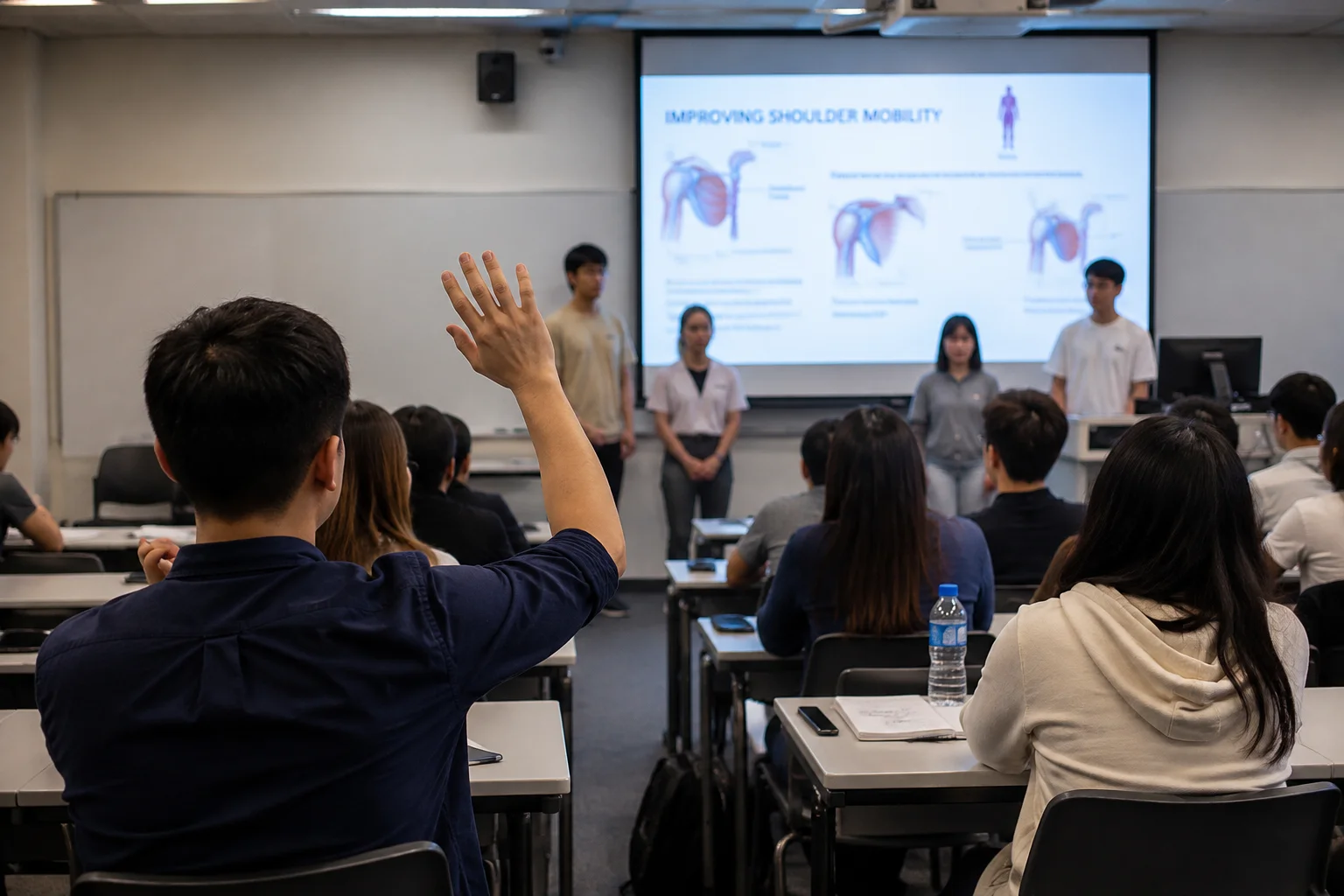
The assessment retained a collaborative movement-analysis project and group presentation. The important development was a structured randomised group viva defence after the presentation. Any group member may be selected to answer about any substantive component of the group’s analysis, whether or not they prepared or presented that section.
- AI-supported preparation: groups develop a movement analysis within the task’s stated AI boundaries. They remain responsible for source verification, biomechanical interpretation, evidence and final judgement.
- Collaborative construction: members prepare a shared analysis, examining how its explanations and recommendations fit together. The submission belongs to the group, rather than being a bundle of isolated sections.
- Group presentation: the group presents the movement analysis and its recommendations.
- Structured randomised group viva: the assessor randomly selects who responds. Questions may concern explanation, justification, evidence, interpretation, limitations or application anywhere within the submitted analysis. The respondent need not be the person who presented that part.
- Individual accountability and human judgement: oral responses provide additional evidence of individual understanding alongside the shared artefact. The assessor interprets that evidence using the assessment criteria; AI does not make the academic judgement.
AI-supported preparation → Collaborative analysis → Group presentation → Structured randomised viva defence → Individual accountability → Human judgement
The shorter version is: Prepare → Collaborate → Present → Defend any part → Justify. AI may help create the artefact. The group owns it. The viva adds evidence about the understanding of the people responsible for it.
Why random questioning?
Group work can become a division-of-labour exercise: one person knows one section, another knows the next, and nobody can explain the whole argument. Allocating questions only to the person who prepared each section can leave that fragmentation intact.
If every group member knows that any part of the analysis may become their question, dividing the assignment into isolated pieces becomes a much weaker strategy. The design gives members a reason to teach one another, examine connections and prepare beyond their own slides.
The intention is to make individual accountability part of a collaborative task, giving members a reason to help one another understand the whole analysis.
What this redesign is grounded in
AIAS: why AI can remain available
The AI Assessment Scale offers a way to align permitted AI use with learning outcomes and assessment purpose (Furze et al., 2024; Perkins et al., 2025). It is not a reason to permit every use, and attaching a label to an unchanged task is not sufficient redesign.
For this task, AI prohibition is not itself the learning outcome. AI can remain available during preparation while learners must still verify claims, understand the biomechanics and take responsibility for the argument. The framework helps me make that relationship between permitted support and expected understanding explicit.
Assessment validity: why the artefact is no longer enough
Dawson et al. (2024) argue for focusing on validity rather than treating rule compliance as the assessment’s ultimate purpose. In an AI-rich environment, I need to ask whether the available evidence supports the inference I want to make about a learner’s reasoning.
The assessment problem therefore became a validity problem rather than simply an AI-detection problem. What evidence would allow me to make a defensible judgement about the reasoning behind the submitted work? A presentation and a live defence provide different evidence. Together, they give the assessor a broader basis for judgement.
Social interdependence and individual accountability
Social Interdependence Theory provides a useful lens for understanding the collaborative design. Cooperative-learning scholarship brings together positive interdependence, a shared outcome that members work towards, and individual accountability, the requirement for each member to demonstrate learning (Johnson & Johnson, 1999). The group presentation provides a shared product; the viva introduces accountability within that product.
Sarfo and Elen (2011) investigated preparation and accountability arrangements, including random selection for examination after group work. The connection is the incentive to prepare together while remaining individually accountable. My design does not adopt their arrangement of using a selected response to determine a shared score.
This theoretical lens explains why the work remains collaborative while understanding should extend beyond an individual’s allocated section. It also cautions against assuming that dividing access to content automatically produces shared understanding.
Self-explanation: why articulating reasoning matters
Chi et al. (1994) examined how prompting learners to generate explanations can support integration of new information with existing knowledge. Asking why a biomechanical interpretation or recommendation makes sense is conceptually consistent with that emphasis on explanation.
A viva differs from the learning intervention Chi and colleagues studied, but their work helps explain why generating an explanation matters, beyond simply giving an answer.
Evaluative judgement: why learners must judge AI-supported work
Bearman et al. (2024) consider the importance of judging quality when working with generative AI. For Movement Science, a fluent answer still needs examination: is the explanation credible, does the evidence support it, and is the biomechanical interpretation defensible?
Learners need to decide what to retain, revise or reject. The viva can ask them to explain those decisions and acknowledge uncertainty. The emphasis shifts from producing a plausible answer to taking responsibility for its quality.
Random does not mean arbitrary
The strongest version of this design makes the person answering unpredictable while the learning domains, expected standard and marking criteria remain predictable. Randomness determines who responds; it should not determine the academic standard they face.
Traditional unstructured oral examinations can vary in difficulty, examiner approach and coverage. Work on examiner preparation and structured oral assessment reinforces the need to attend to those conditions (Joseph et al., 2022; Loomba & Jindal, 2024).
The design principles are:
- Predetermine domains mapped to intended learning outcomes and assessment criteria, including biomechanical reasoning, evidence, interpretation and application.
- Sample questions of comparable demand across groups and allow follow-up prompts for explanation, justification and limitations.
- Use common marking criteria, make the format and expected standard clear in advance, and prepare assessors for consistent interpretation.
- Give learners opportunities to practise oral explanation and retain reasonable accessibility adjustments. Verbal speed or confidence should not substitute for the reasoning being assessed.
- Consider coverage and the amount of evidence available for each individual; a small random sample cannot guarantee comprehensive assessment.
The practical task is to translate these principles into consistent questions, scoring and access arrangements. Random selection is only one part of that work.
An evidence strategy, not AI detection
The viva is not intended to identify whether AI was used. AI use was already permitted within the stated boundaries. Its purpose is to collect another form of evidence about understanding, reasoning and accountability.
Recent work examines a related approach more directly. Hutson et al. (2026) piloted Integrevise™, pairing submitted work with a short adaptive viva in which learners explain their reasoning and application. Their account highlights the importance of clear expectations, implementation and learners’ understanding of the viva’s purpose, rather than simply adding an oral component. This platform-based pilot is a related example, rather than a test of my lecturer-led group viva.
The central question is no longer: did AI help create this presentation? It is: can any member of the group, if selected, explain, justify and defend the reasoning behind what the group has submitted? AI can assist the product. It cannot carry responsibility for the group’s understanding.
The viva deliberately reconnects the finished artefact with the people responsible for it.
I am less interested in making an assessment “AI-proof” than in ensuring that AI use does not make human understanding optional.
What I still need to evaluate
These frameworks explain my design choices; they do not establish the effects of this particular assessment. I still need to examine question equivalence, assessor consistency, accessibility and the coverage of individual responses, alongside whether the approach encourages shared preparation rather than strategic rehearsal. Any claim about improved learning, clinical competence, fairness or reliability would need evaluation.
An unseen transfer task could add evidence about applying reasoning beyond a prepared example. It remains a proposed next iteration, not an implemented or evaluated component of this account.
The aim is an assessment designed for an AI-rich environment: collaborative work remains worthwhile, AI-supported preparation remains possible, and human reasoning remains necessary.
References
Bearman, M., Tai, J., Dawson, P., Boud, D., & Ajjawi, R. (2024). Developing evaluative judgement for a time of generative artificial intelligence. Assessment & Evaluation in Higher Education, 49(6), 893–905. https://doi.org/10.1080/02602938.2024.2335321
Chi, M. T. H., De Leeuw, N., Chiu, M.-H., & Lavancher, C. (1994). Eliciting self-explanations improves understanding. Cognitive Science, 18(3), 439–477. https://doi.org/10.1207/s15516709cog1803_3
Dawson, P., Bearman, M., Dollinger, M., & Boud, D. (2024). Validity matters more than cheating. Assessment & Evaluation in Higher Education, 49(7), 1005–1016. https://doi.org/10.1080/02602938.2024.2386662
Furze, L., Perkins, M., Roe, J., & MacVaugh, J. (2024). The AI Assessment Scale (AIAS) in action: A pilot implementation of GenAI-supported assessment. Australasian Journal of Educational Technology, 40(4), 38–55. https://doi.org/10.14742/ajet.9434
Johnson, D. W., & Johnson, R. T. (1999). Making cooperative learning work. Theory Into Practice, 38(2), 67–73. https://doi.org/10.1080/00405849909543834
Joseph, N., Rai, S., Singh, V. P., Karnad, S. D., & Kadur, K. (2022). Effectiveness of an Online Viva Voce Workshop in Improving the Knowledge of Faculties of Various Health Science Courses in Mangalore, India. Education and Self Development, 17(2), 9–25. https://doi.org/10.26907/esd.17.2.04
Loomba, R., & Jindal, N. M. (2024). Improving process aspect of oral examination as assessment tool in undergraduate biochemistry by introducing structured oral examination: an observational study in India based on a survey among stakeholders. Korean Journal of Medical Education, 36(4), 367–377. https://doi.org/10.3946/kjme.2024.310
Perkins, M., Roe, J., & Furze, L. (2025). How (not) to use the AI Assessment Scale. Journal of Applied Learning & Teaching, 8(2), 14–23. https://doi.org/10.37074/jalt.2025.8.2.15
Sarfo, F. K., & Elen, J. (2011). Investigating the impact of positive resource interdependence and individual accountability on students’ academic performance in cooperative learning. Electronic Journal of Research in Educational Psychology, 9(1), 73–94. https://doi.org/10.25115/ejrep.v9i23.1428
Hutson, J., Poyer, K., Ogoe, E., & Atologun, K. A. (2026). Beyond AI Detection: A Pilot Study of Integrevise™ and Viva-Based Verification of Student Understanding in AI-Mediated Assessment. Trends in Higher Education, 5(3), 59. https://doi.org/10.3390/higheredu5030059