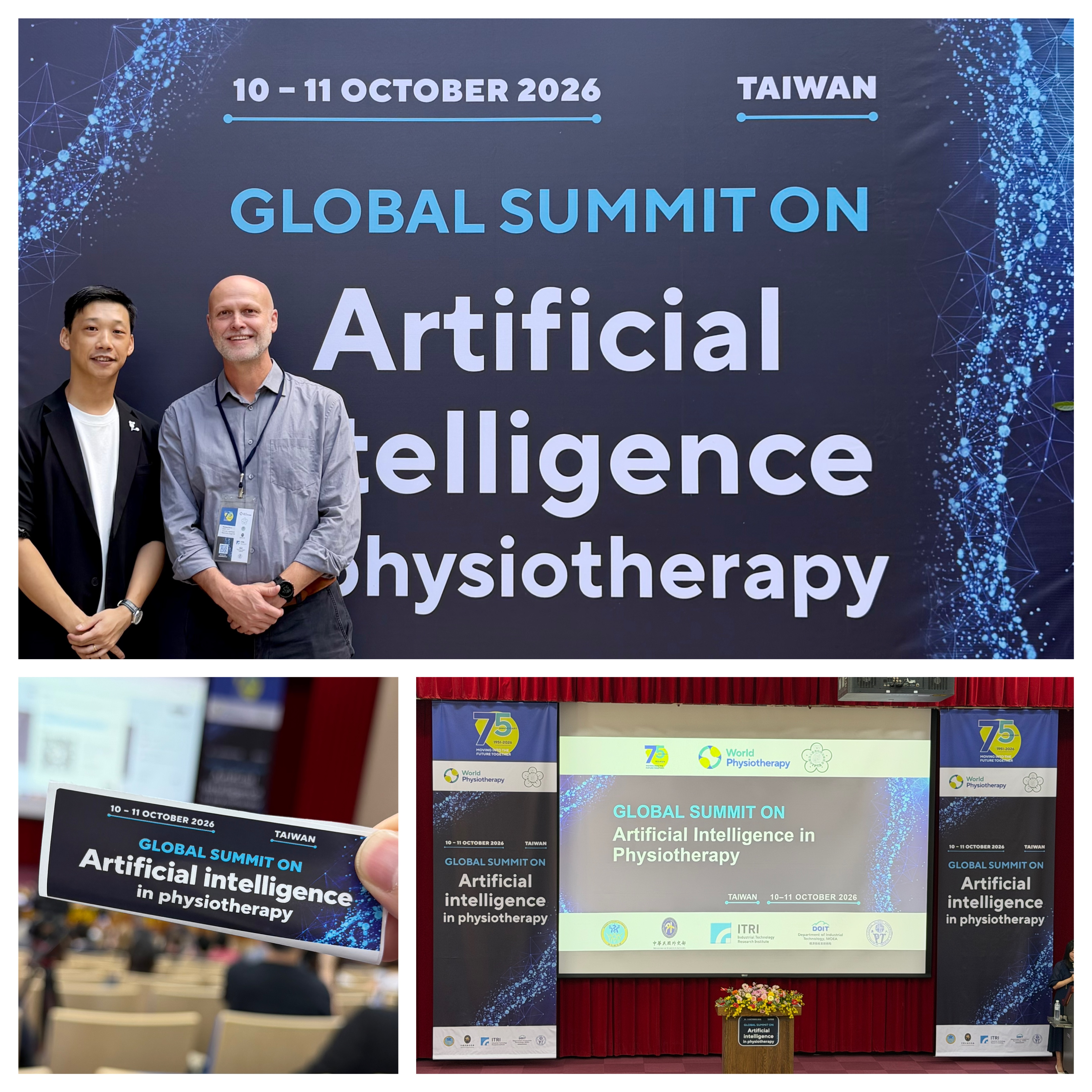
The question I am taking away from the World Physiotherapy Global Summit on Artificial Intelligence in Physiotherapy is practical: what would responsible AI look like in the work I do every day?
The summit took place in Taipei, Taiwan, on 10–11 October 2026, bringing education, research and practice into the same conversation. Its stated aim was a practical global framework for considered and ethical AI use. For someone working across physiotherapy education, clinical reasoning and technology-supported learning, that is a useful starting point: our decisions about AI need to connect across these settings.
About this reflection: the eight themes below are my paraphrase of the principles presented at the closing ceremony, checked against my recording. They are not an official transcript or a substitute for World Physiotherapy’s eventual published wording. The speakers described further publication and implementation work to come. The examples of application are my own proposals, not summit recommendations or claims of demonstrated effectiveness.
Eight principles to bring back into everyday work
The closing presentation explained that these principles form a shared core across education, research and practice. They were not presented in a hierarchy; the numbering here is simply for readability.
1. Human-centredness and connection
AI should support human connection where it matters. The closing presentation acknowledged that human support is not equally available or desired in every setting. For me, this means asking which relationships an educational tool strengthens, and which it might unintentionally displace. Faster feedback is useful, but students still need opportunities to discuss uncertainty with peers and educators.
2. Transparency and informed choice
People affected by AI need understandable explanations of its role, benefits and limitations, together with realistic opportunities to question, challenge or decline its use where feasible. In my teaching, I would want students to know when feedback comes from AI, what information is being used and how they can seek human review. A notice should help someone make a decision, rather than merely announce that AI is present.
3. Professional capability
Using AI responsibly requires capability appropriate to one’s role, independent judgement and the retention of necessary professional skills. I would interpret this as knowing when to use a tool, verify its output, ask for help or stop. Students should be able to explain their reasoning without relying on an AI-generated answer to speak for them.
4. Equity and accessibility
AI should support inclusion without introducing or worsening discrimination. The presentation cautioned against assuming that evidence from one population transfers automatically to another. For my work, language, disability, device access and the populations represented in testing would need attention. A movement-analysis demonstration working well for one person does not establish that it works equally well for everyone.
5. Proportionate evidence
The evidence needed should match the risks and consequences of the intended use. Organising a teaching resource and informing a clinical decision are different tasks. I would therefore separate low-risk experimentation from higher-stakes uses, and require stronger evaluation as the consequences increase. A successful demonstration shows that something can run; it does not establish that a measurement is valid.
6. Purpose and benefit
AI should address a clearly defined need and offer value over reasonable alternatives. The presentation also asked us to consider financial, ethical, social and environmental costs, and who receives the benefits or carries the burden. My first question would be what problem needs solving, followed by whether a simpler non-AI approach could solve it adequately.
7. Human accountability and shared responsibility
Responsibility for AI use needs to be clearly allocated and communicated. An educator, clinician, institution and technology provider may have different responsibilities; these should not disappear behind an automated output. In a learning tool, I would want an explicit route for reporting misleading feedback and a named responsibility for reviewing it.
8. Governance and lifecycle management
Oversight should begin before a tool is selected and continue through implementation, use and retirement. Models change, workflows change and new groups may use a tool in ways its initial testing did not cover. I would treat approval as the beginning of a review process, with checks after significant changes and a way to withdraw a tool when it no longer serves its purpose.
How I might use them in my work
I would begin with a small number of concrete design decisions, rather than treating the principles as a statement to place on a website and forget.
Keep reasoning visible in AI-supported learning
In an AI tutor, I would want students to make an initial judgement, explain it, receive a question or a targeted hint, and then revisit their reasoning. The tutor should make the student’s thinking easier to examine. It should also make uncertainty visible and offer a route back to an educator when its feedback is unclear or inappropriate.
This gives me an evaluation question: can students explain and transfer what they have learned after the assistance is removed? A fluent conversation or a favourable satisfaction rating would not answer that on its own.
Separate technical performance from AI assistance in the Skills Lab
For the Student Skills Lab, I would keep deterministic game scoring separate from the tutor’s formative feedback. The game should calculate the practice score; AI should not alter the authoritative score or decide whether an anatomical target is correct.
I would also examine accuracy and independence separately. Hint use can be useful learning information without automatically reducing technical accuracy. Students should understand what is recorded, what their score means and why it does not certify clinical competence. Accessibility and the possibility of misleading feedback would remain part of the review.
Evaluate and maintain the work after the demonstration
For a pilot, I would examine feasibility, accessibility, learner reasoning and the kinds of errors or misunderstandings the tool produces. I would document its version and intended use, assign responsibility for reviewing problems and repeat relevant checks after changes. Any evaluation involving students or patient information would need the appropriate institutional arrangements.
These are possible next steps, not results I can claim already. The value of the summit for my work is that it offers questions to carry into design, teaching and evaluation—and reasons to change direction when a tool does not meet the need.
From principles to decisions
I remain interested in what AI can make possible for physiotherapy education. I also want the work to be open to challenge: why this tool, for this learner or clinician, in this setting, with this evidence? That is the conversation I would like to keep going after Taipei.
Sources and context
- World Physiotherapy: summit overview.
- Official programme, including the public closing ceremony on 11 October.
- My recording of the closing ceremony, 11 October 2026: explanation of the shared core and ordering at approximately 05:23–07:12; the eight principles at approximately 07:13–16:00. Recording and transcript remain private. Principle headings use British English; explanations above are paraphrases.