I have tools that can summarise a reading, organise an argument and turn rough ideas into polished prose. I use them, and I am interested in what they make possible.
Yet I still write things down.
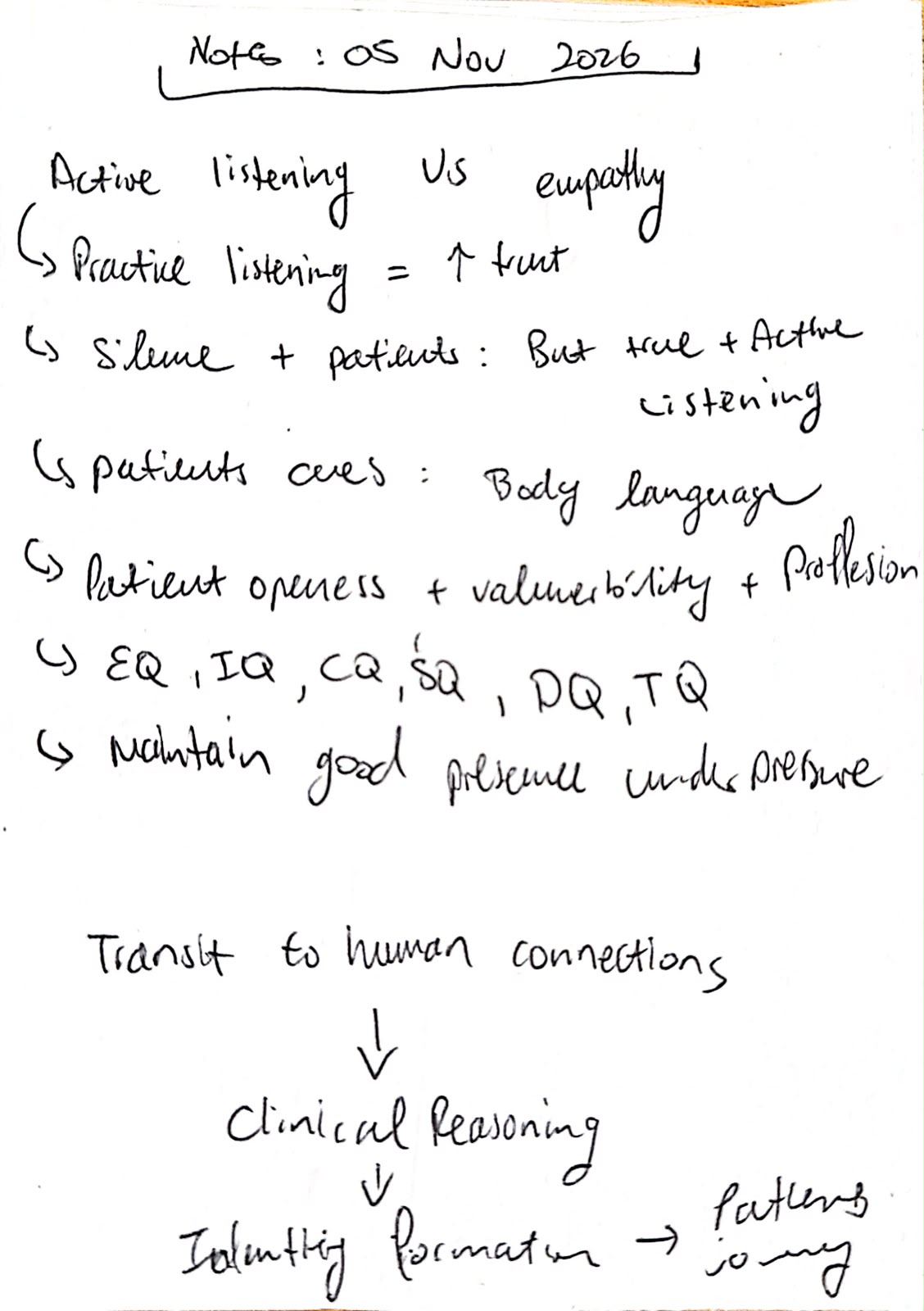
The handwritten page accompanying this post is a small example: active listening, patient cues, body language, human connection and clinical reasoning. Arrows connect one thought to another. It is a working page, with the unevenness that comes with that.
There is just something about pen and paper that I like. That is a personal preference. The educational question it brings to mind is broader:
If a tool makes the answer easier to produce, does it also make the learning better?
A better answer and a better learner
Generative AI can help a student produce a clearer explanation or a more convincing assignment. That is useful. But the quality of the final answer does not tell us, on its own, what the learner can explain, apply or defend afterwards.
I think of this as the AI learning paradox: supported performance can improve while independent learning does not improve to the same extent.
Bastani and colleagues (2025) provide a concrete example. In a field experiment with nearly 1,000 high-school mathematics students, access to GPT-4 improved practice performance. When access was removed, students using the unrestricted version performed 17% worse than the no-AI group. A tutor designed with learning safeguards largely mitigated that negative effect.
The 17% refers to a relative reduction in grades in that particular study, not a universal penalty for using AI. Its published correction concerns an author affiliation. The important educational finding is that the design of the assistance mattered.
What happens to the work between question and answer?
When I read, compare sources, decide what matters and try to explain it, I am doing more than collecting information. I am attempting to make sense of it. An AI synthesis can arrive after much of that work has already been done for me.
Melumad and Yun (2025) compared LLM-based learning with conventional web search across seven experiments involving 10,462 participants. Their findings were consistent with shallower learning in the study tasks: participants using LLM syntheses reported shallower knowledge and produced advice that was sparser and less original.
That does not mean every summary is harmful or every search is productive. It raises a design question: which activities does this tool help the learner practise, and which does it let them skip?
PISA raises questions; it does not settle causation
Recent OECD commentary on PISA 2025 links AI use, reading and critical evaluation. It is worth engaging with, but an association between reported AI use and achievement cannot establish that AI caused the difference (OECD, 2026).
Nor is there a single uniform association. A working paper using PISA data from 24 countries reports substantial cross-country variation (Rusinov, 2026). It remains emerging, observational evidence. Such variation does not identify teacher guidance or curriculum design as the cause, even if these are sensible possibilities to investigate.
I would therefore avoid the claim that “AI is lowering PISA scores.” The more useful question is what students do with AI, in which setting, and what they can subsequently do independently.
Writing can be part of the learning
The term I was looking for is writing to learn.
Graham, Kiuhara and MacKay (2020) synthesised 56 experiments in Grades 1–12 and found that writing about science, social studies and mathematics content improved learning on average, with a reported effect size of 0.30. Graham and Hebert (2011) also found that writing about material read improved reading comprehension.
These findings support something more precise than “writing makes learning easy”:
Writing can be part of how we learn, not just a way of displaying what we have learned.
That sentence is my synthesis, rather than a quotation from either paper. The research does not show that every writing activity helps, that handwriting is always better than typing, or that AI-assisted writing necessarily harms learning.
For me, the handwritten page is a reminder to make the connections myself. Putting an arrow between human connection and clinical reasoning makes me pause over the relationship. What do I mean by that connection? What example would support it? What have I left unexplained?
I like the physical act of writing. The teaching principle I take from this is to preserve the learner’s opportunity to construct an explanation, whatever medium they use.
A routine I would like to encourage
I would like students to try a sequence like this:
- Read or attempt the problem first.
- Write a short explanation in their own words, including what remains uncertain.
- Ask AI to challenge the explanation or offer one hint.
- Check the evidence and revise the explanation themselves.
- Close the tool and explain or apply the idea again.
This is a teaching proposal informed by the evidence, rather than a routine validated by those particular studies. Its value should be judged by later understanding and transfer.
In physiotherapy education, I might ask a student to explain a movement-analysis decision, use AI to challenge the reasoning, then defend the decision in a new case. The polished preparation would be one source of evidence. The student’s explanation would be another.
Keeping the thinking visible
I want the benefits of these tools. I also want to keep asking where the learning is happening.
Sometimes that will mean a conversation with AI. Sometimes it will mean a question from a teacher, a practical demonstration, or a paragraph written without assistance.
And sometimes, for me, it will still mean a pen, a sheet of paper, and a few arrows between unfinished thoughts.
There is something about that process that I want to keep.
References
- Bastani, H., Bastani, O., Sungu, A., Ge, H., Kabakcı, Ö., & Mariman, R. (2025). Generative AI without guardrails can harm learning: Evidence from high school mathematics. PNAS, 122(26), e2422633122. Article. Affiliation correction.
- Graham, S., Kiuhara, S. A., & MacKay, M. (2020). The effects of writing on learning in science, social studies, and mathematics: A meta-analysis. Review of Educational Research, 90(2), 179–226. Article.
- Graham, S., & Hebert, M. (2011). Writing to read: A meta-analysis of the impact of writing and writing instruction on reading. Harvard Educational Review, 81(4), 710–744. Article.
- Melumad, S., & Yun, J. H. (2025). Experimental evidence of the effects of large language models versus web search on depth of learning. PNAS Nexus, 4(10), pgaf316. Article.
- Organisation for Economic Co-operation and Development. (2026, September 8). PISA findings on artificial intelligence use, reading skills and learning [Video commentary]. OECD.
- Rusinov, S. (2026). When does AI help students learn? Cross-country heterogeneity in the association between generative AI use and PISA achievement [Working paper]. SSRN.