Virtual reality is naturally attractive to universities. It is immersive, visually impressive and easy to associate with innovation. A room containing headsets can signal investment in the future; educators can imagine new forms of teaching, while students are often curious about learning through an unfamiliar medium.
That initial excitement is valuable. The difficulty begins when novelty becomes the reason for adoption rather than the beginning of an educational conversation.
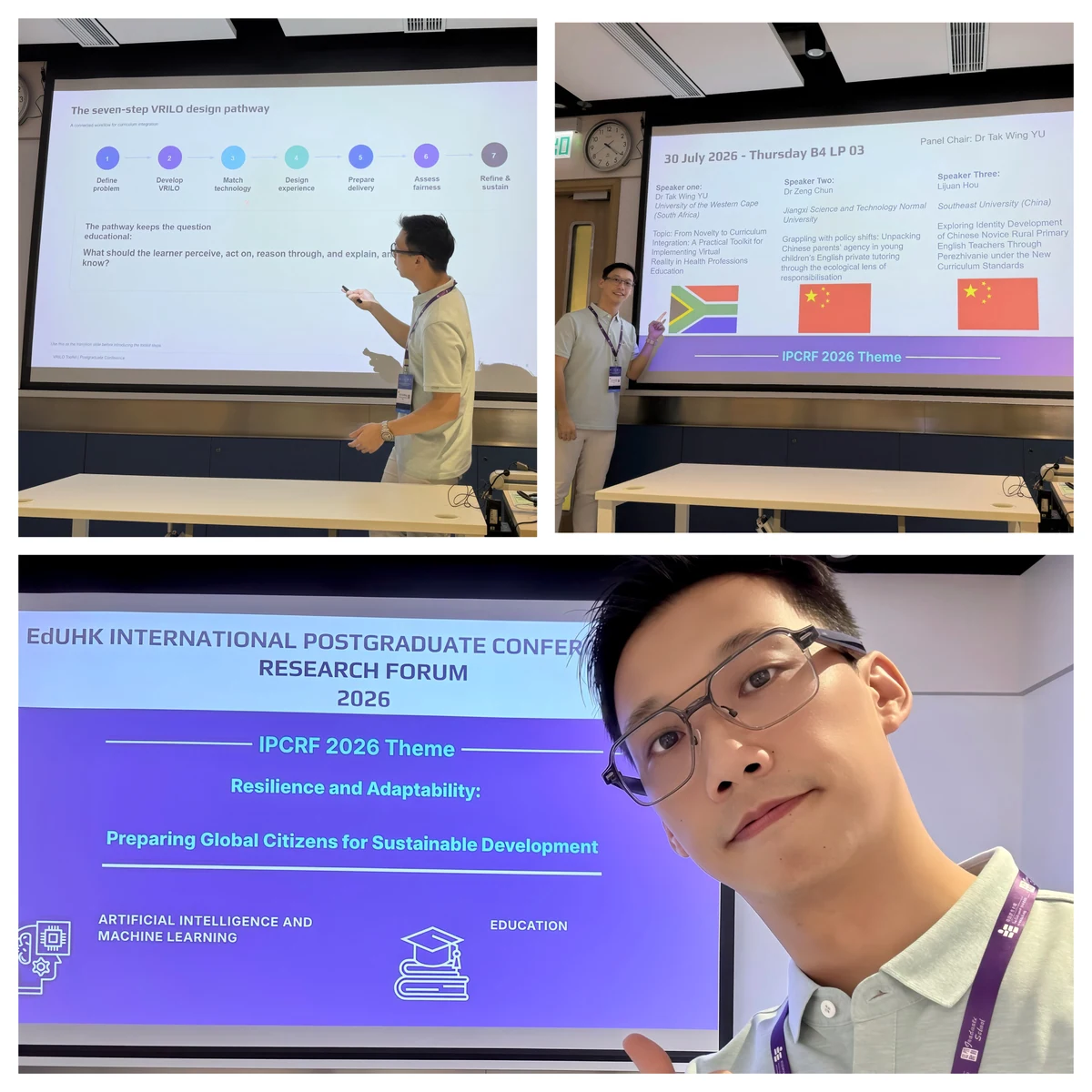
I presented this reflection alongside the seven-step VRILO design pathway at the EdUHK International Postgraduate Conference and Research Forum 2026. The pathway grew from a recurring question in my work: how do we move VR from an impressive demonstration towards purposeful and sustainable curriculum integration?
The educational value of embodiment
My interest in immersive learning is partly informed by my South African background and an awareness of the continuing legacy of apartheid. That history has made me attentive to the importance of context, perspective and lived experience. Learning is not purely cognitive; it is also shaped by where we stand, what we perceive and how we interact with an environment.
VR can introduce an element of embodiment by allowing learners to explore a situation spatially and act from a particular position. This does not mean that a simulation can reproduce another person's lived experience or allow someone to fully understand apartheid, inequality or exclusion. Technology should not make that claim. At its best, a carefully designed experience can prompt learners to notice perspectives, environments and barriers that text alone may leave abstract.
Embodiment is also directly relevant to physiotherapy education. Students learn about bodies, movement, space and human interaction. Visualisation and active exploration may help them connect anatomical structures, movement patterns and clinical situations in ways that are difficult to achieve through a flat image alone.
When buying technology becomes the strategy
Universities may approach VR as something they should purchase because other institutions are using it, funding is available, or suitable facilities appear to exist. The launch can be impressive: headsets arrive, a room is prepared and staff organise demonstrations.
Yet owning the equipment is not the same as having an implementation plan. The first activities may go well because enthusiastic staff contribute additional time and solve problems informally. The weaknesses become visible later, when the programme depends on routine staffing, maintenance and coordination rather than launch-day energy.
This is where novelty can become a liability. If the technology was never connected to a defined learning problem, it becomes difficult to decide what should be sustained, what should be evaluated and who should remain responsible for it.
Why promising projects fall short
Sustainable VR requires more than headsets and goodwill. It requires staff time for learning design and facilitation, technical support, appropriate room space, device management, charging, software maintenance, reliable connectivity and plans for cleaning and safe use.
It also requires attention to learner preparation, accessibility, cybersickness, acceptability, group size and alternatives for students who cannot or should not use a headset. These are not peripheral operational details. They shape whether students can participate and whether the intended learning experience can occur consistently.
A university may therefore possess both facilities and capable staff, yet still struggle to sustain VR if responsibilities, recurrent costs and protected time were not allocated from the beginning.
Technology is rarely the learning problem
The new technology is seldom the central problem. The more important question is what educators want learners to perceive, practise, reason through, explain or solve.
Before selecting VR, we should define the learning intention. What should students know or be able to do afterwards? What difficulty are they currently experiencing? Why would immersion, embodiment or spatial visualisation address that difficulty more appropriately than another teaching approach? What evidence would show that learning has occurred?
An activity should not be included simply because it is enjoyable or impressive. Enjoyment can support engagement, but engagement is not automatically evidence of learning. The intended outcome should determine the activity, and the assessment should make the relevant learning visible.
Questions to ask before purchasing VR
- What educational problem is the technology expected to address?
- What are the intended learning outcomes, and why does VR suit them?
- Who will design, facilitate, maintain and evaluate the experience?
- Is suitable room space available for safe use and group teaching?
- How will devices be stored, charged, cleaned, updated and connected?
- What software licences and recurrent costs must be sustained?
- How will students be prepared, supported and debriefed?
- How will accessibility, cybersickness and alternative participation be addressed?
- What evidence will be collected to decide whether the experience should continue?
From novelty to curriculum integration
The VRILO design pathway is my attempt to keep the educational question visible throughout implementation. Its seven steps are to define the problem, develop the intended VR-integrated learning outcomes, match the technology, design the experience, prepare delivery, assess fairness, and refine and sustain the work.
The pathway does not assume that VR is always the answer. It may lead educators to use VR differently, combine it with another approach or decide that it is unnecessary. That is a strength rather than a failure: responsible educational design includes knowing when not to use a technology.
The question universities should ask is therefore not simply, How can we use VR? It is: What educational problem are we trying to solve, and does VR offer an appropriate, equitable and sustainable way to address it?
Novelty can attract attention and create permission to experiment. Educational value emerges only when that attention is converted into a clear learning intention, thoughtful design, sufficient support and evidence that matters.
Related research
- Yu, T. W., Rowe, M., & Frantz, J. (2026). Virtual Reality in Health Professions Education: Qualitative Descriptive Study of Educators' Perspectives. JMIR XR and Spatial Computing, 3, e52925. https://doi.org/10.2196/52925.
- Yu, T. W., Rowe, M., & Frantz, J. (2025). Virtual reality, higher education, learning outcomes, technology, teaching and learning [Preprint]. EdArXiv. https://doi.org/10.35542/osf.io/wnx8b_v1.