The patient does not arrive as a multiple-choice question.
They arrive as a person: perhaps frightened, frustrated, tired, uncertain, or simply not ready to do what the clinician recommends.
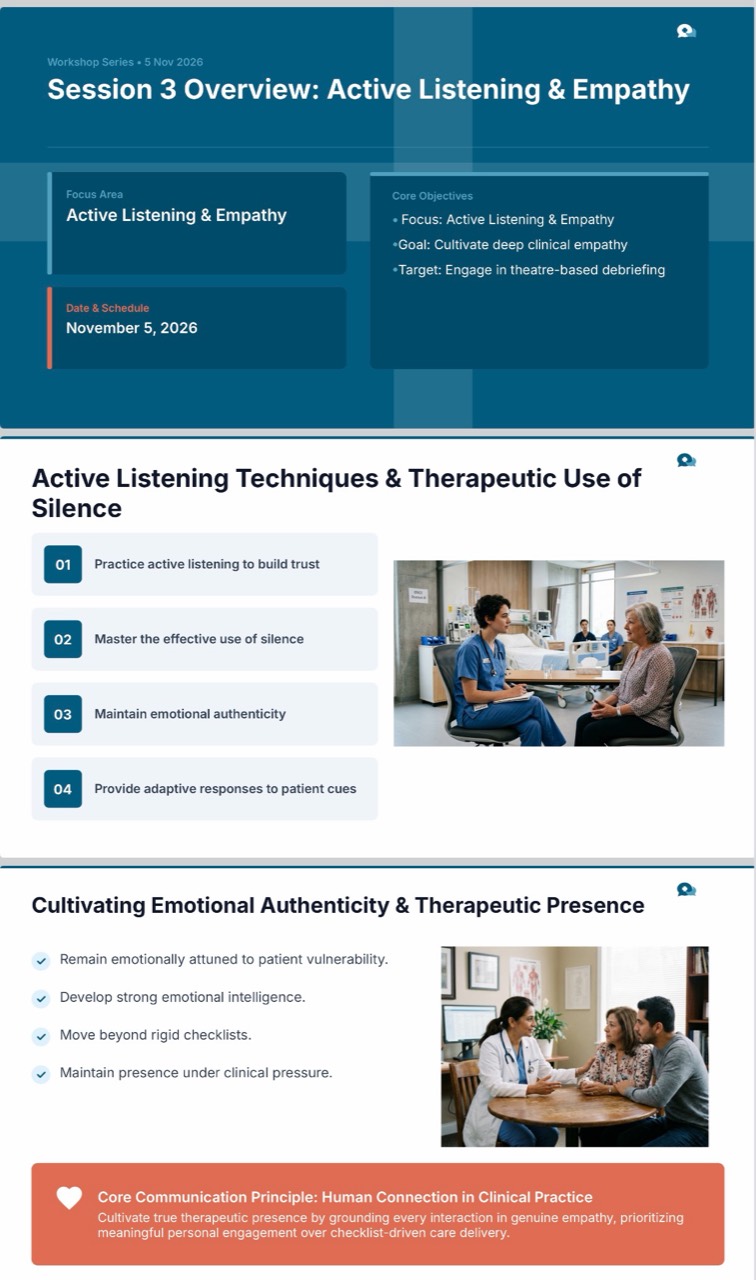
I took part in a recent Year 4 physiotherapy workshop as part of a wider simulation programme. I facilitated the introduction and debriefing to support the students’ learning, while also learning from the experience myself. Professional actors worked with students on listening, rapport, emotional cues, body language, tone and silence. The session asked learners to respond when an interaction moved beyond the expected script.
Taking part as both a learner and a facilitator made me reconsider what we mean when we say that a student is ready for practice.
Knowing the answer is only part of the encounter
Clinical knowledge and technical competence remain essential. A physiotherapist needs anatomy, physiology, pathology, assessment skills and sound clinical reasoning. But a student can know what an intervention involves and still struggle to explain it to someone who is anxious or hesitant.
They may have a sensible rehabilitation plan but miss the reason a patient is reluctant to follow it. They may identify the clinical problem while failing to notice that the person in front of them feels unheard.
The workshop gave students an opportunity to practise that human side of the encounter. The actors were more than a way to make a scenario look realistic. Their perspective could help students consider how their communication felt to the person receiving it.
That is a different question from whether the student remembered the right information.
Emotional intelligence became visible
Emotional intelligence is not a single universally agreed construct. One useful lens comes from Maity and colleagues’ (2025) systematic review of interventions in medical education, which mapped themes onto four domains: self-awareness, self-management, social awareness and relationship management.
Those domains gave me a way to interpret what students were practising.
Self-awareness: what is happening inside me?
A learner may notice nervousness before approaching a patient, frustration when advice is rejected, or a tendency to speak faster when uncertain. Noticing those responses creates an opportunity to consider how they affect the interaction.
Self-management: how do I respond?
Imagine a patient declining an intervention the student considers important. Repeating the advice more forcefully may not help. The student may need to slow down, tolerate silence, ask about the hesitation and reconsider the timing of the conversation.
For me, the aim is to recognise emotion and choose a professional response. It does not require becoming emotionless.
Social awareness: what might the patient be experiencing?
The patient may be worried about pain, embarrassed, overwhelmed, or concerned about responsibilities at home. A clinically reasonable recommendation can be difficult to receive in that context.
Listening for those cues is part of understanding the situation. It also gives empathy a practical expression: asking, noticing and checking rather than assuming we know how someone feels.
Relationship management: what does this interaction feel like?
Can the learner maintain trust during disagreement? Can they negotiate, preserve dignity and recover when a conversation has not gone well?
These are questions I take from the workshop, rather than claims that this session measured or improved each capability. The review also cautions that self-reported gains may overestimate change and that sustained behaviour in practice needs further evaluation (Maity et al., 2025).
The patient perspective adds something
Reeves, Waite and Tuttle (2019) studied 15 exercise-physiology students undertaking communication-focused simulation modules. Students reported improvements in confidence and perceived preparedness. Those findings support interest in this approach, but they are perceptions from a small cohort—not proof of improved clinical competence or patient outcomes.
The point that stays with me is the opportunity to receive a response from the patient’s side of the conversation. A clinician educator can examine the clinical reasoning; a simulated patient can contribute a perspective on being listened to, respected and involved.
I would want students to engage with both.
A safe place to try something difficult
Practising communication can expose a learner’s uncertainty. It can feel personal when the feedback concerns tone, body language or an emotional response.
When facilitating the introduction, I wanted to help students understand the purpose of the session and feel able to participate, make mistakes and learn. A clear prebrief therefore matters. Rudolph and colleagues (2014) describe practices for creating a psychologically safe container, including clarifying expectations and demonstrating respect for learners. This is a design argument about enabling participation and discussion of mistakes, rather than a guarantee that a briefing makes everyone feel safe.
I want a learning environment where students can attempt, receive feedback and try again without humiliation. Challenge still belongs there. So does care.
The reflection afterwards matters
The encounter alone is not the whole learning process. In facilitating the debriefing, my role was to help students reflect on the experience and connect it with their learning. Useful questions include: What did you notice? What were you feeling when the patient challenged you? How did that affect your response? What would you change next time?
Duff and colleagues’ (2024) systematic review examines debriefing methods and highlights limitations in the comparative evidence. It gives no basis for assuming that one method is always best. It does reinforce the need to attend to the conversation around actions, thoughts, feelings and performance.
The cycle I want to encourage is simple:
Experience → Notice → Reflect → Adjust → Try again.
That is my teaching interpretation, not an outcome demonstrated by this workshop.
Beyond a collection of quotients
I have previously used “quotient” language to think about student development. This workshop made those ideas more concrete.
Cognitive capability helps a student understand the problem. Emotional awareness helps them notice their own response and the patient’s. Cultural responsiveness, adaptability, relational capability and metacognition may all be needed during the same encounter.
I use these as lenses for reflection. They are not interchangeable measures, and labels such as adaptability quotient, relational quotient and metacognitive quotient do not together form a validated assessment model.
Similarly, thinking of readiness as a product of knowledge, reasoning, communication and judgement is a metaphor. It expresses my concern that a serious weakness in one area can compromise otherwise strong performance. It is not an equation we can use to calculate readiness.
Preparing for the person across the journey
The actor training is preparation for longitudinal simulation: students encounter the same simulated patient across different stages of care. The planned case involves a person living with COPD, heart failure and diabetes, with changing rehabilitation, discharge and family-support needs.
The educational opportunity is to keep the person visible as the clinical situation changes. How does trust develop? What happens when goals differ? How does a student adapt after an earlier conversation has failed?
Those are questions to explore and evaluate as the programme develops. They are not established benefits of the workshop.
Where AI fits into this
AI makes it possible to obtain explanations and draft plans quickly. My concern is that learners still need to interpret those outputs in the context of another person, recognise uncertainty, verify information and take responsibility for decisions.
My view is that easier access to information makes these human dimensions of practice more visible. An answer on a screen does not show whether a patient feels understood or whether a student can respond constructively under pressure.
The workshop reminded me to ask a broader question than “Does this student know enough?”
Can this student bring knowledge, judgement and care into an encounter with another human being?
That is the kind of readiness I want our teaching to support.
This is a personal teaching reflection. The workshop observations are not a formal evaluation of changes in competence or patient outcomes.
References
- Maity, S., De Filippis, S. M., Aldanese, A. M., et al. (2025). Enhancing emotional intelligence in medical education: A systematic review of interventions. Frontiers in Medicine, 12, 1587090. https://doi.org/10.3389/fmed.2025.1587090
- Reeves, N. E., Waite, M., & Tuttle, N. (2019). Simulated patient contributions to enhancing exercise physiology student clinical assessment skills. Advances in Simulation, 4(Suppl 1). https://doi.org/10.1186/s41077-019-0097-6
- Rudolph, J. W., Raemer, D. B., & Simon, R. (2014). Establishing a safe container for learning in simulation: The role of the presimulation briefing. Simulation in Healthcare, 9(6), 339–349. https://doi.org/10.1097/SIH.0000000000000047
- Duff, J. P., Morse, K. J., Seelandt, J., et al. (2024). Debriefing methods for simulation in healthcare. Simulation in Healthcare, 19(1S), S112–S121. https://doi.org/10.1097/SIH.0000000000000765