I recently drafted an assignment that allowed students to use AI. The idea was that students would analyse sport-related movement and injury mechanisms using movement-science principles. AI would help them generate an initial explanation, improve the prompt, compare the outputs and critique the response.
On paper, it looked like the kind of assessment higher education needs now. Students are already using AI. Pretending they are not is not honest, and banning AI everywhere misses a chance to teach critical and responsible use. But the assignment was not used, because AI was not what the assessment was supposed to assess.
The assessment was about movement science
The disciplinary purpose was to assess whether students could analyse normal human movement using anatomical and biomechanical principles, interpret movement variation and apply movement science to functional activity.
That means students need to reason about movement phases, joints, planes, axes, muscle actions, ground reaction force, centre of mass, base of support, tissue loading and injury mechanisms. Once AI was added, the question became harder: are we assessing movement science, or are we assessing AI literacy?
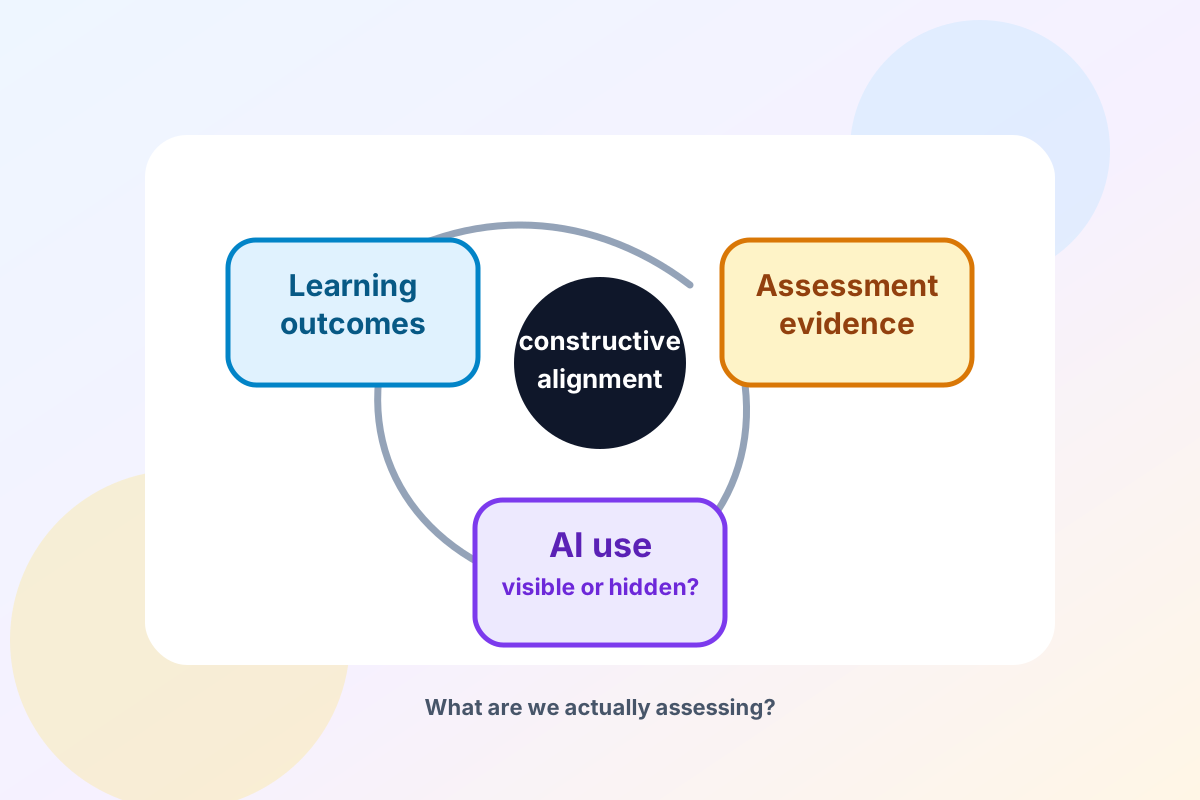
The problem of constructive alignment
Assessment design forces us to ask what we are actually measuring. If the intended outcome is movement-science reasoning, then the assessment should make that reasoning visible.
If marks are given for prompt quality, AI critique or comparison between AI outputs, then AI literacy becomes part of the assessed construct. That is not wrong, but it must be intentional. In this draft, AI use was either too important to ignore or not important enough to assess. That made the design unstable.
Assessment must change, but not accidentally
AI has made some traditional assessment assumptions fragile. Students can now generate fluent explanations, summaries and drafts very quickly. A polished final product no longer tells us enough about understanding.
But assessment should not change simply by adding AI into an existing task. The deeper change is to clarify what the task values: disciplinary reasoning, professional judgement, evidence use, communication, AI literacy, reflection or accountability.
The fairness problem
Students do not arrive with equal AI experience. If assessment rewards AI skill before that skill is taught, it may assess prior exposure as much as learning.
In health professions education, using a chatbot is not the same as using AI safely, critically or professionally. Better-looking work may not mean better clinical or biomechanical reasoning.
A better version of the idea
A better version might keep AI critique as a formative activity. Students could compare weak and improved AI outputs, identify missing movement-science reasoning and use AI as a teaching tool rather than an assessed construct.
Another version would explicitly add AI literacy to the curriculum, teach it properly, define performance standards and assess it transparently. A third version would assess the reasoning trail: what students checked, rejected and revised, while marking disciplinary reasoning rather than prompt sophistication.
What I learned from not using it
Not executing the assignment was not a failure. It clarified the design problem. The better question is not whether AI should be allowed, but what the assessment is trying to make visible.
If the goal is movement-science reasoning, AI must not obscure that reasoning. If the goal is AI literacy, then AI literacy must be taught and assessed as its own capability. Assessment in the AI era must change through alignment, not anxiety.
The unresolved question
We often say that we cannot assess students on AI use because we do not yet know how good or bad they are at using it. But what about staff?
If staff design AI-permitted assessments, define acceptable use and judge responsible use, then staff AI literacy matters too. That is probably the next post.