
I recently gave two AI assistants the same apparently ordinary task: use a lesson timetable to help manage a series of calendar events. The contrast between their responses was striking.
In one workflow, ChatGPT reviewed the timetable, checked existing events and updated the venues that had changed. I could then see the revised events in my calendar. In the other, Copilot could read the schedule but repeatedly told me that it could not create the events, even after I reduced the request to the first three lessons.
My first reaction was predictable: one system had succeeded and the other had failed. On reflection, that conclusion was too simple.
One timetable, two outcomes
The screenshots record what happened in my particular accounts and interfaces at that moment. They do not establish a controlled comparison between underlying models. The assistants may have had different connectors, permissions, product settings, account policies or access to contextual data.
That qualification is important. What looked like a difference in intelligence may have been a difference in the surrounding system's authority to act.
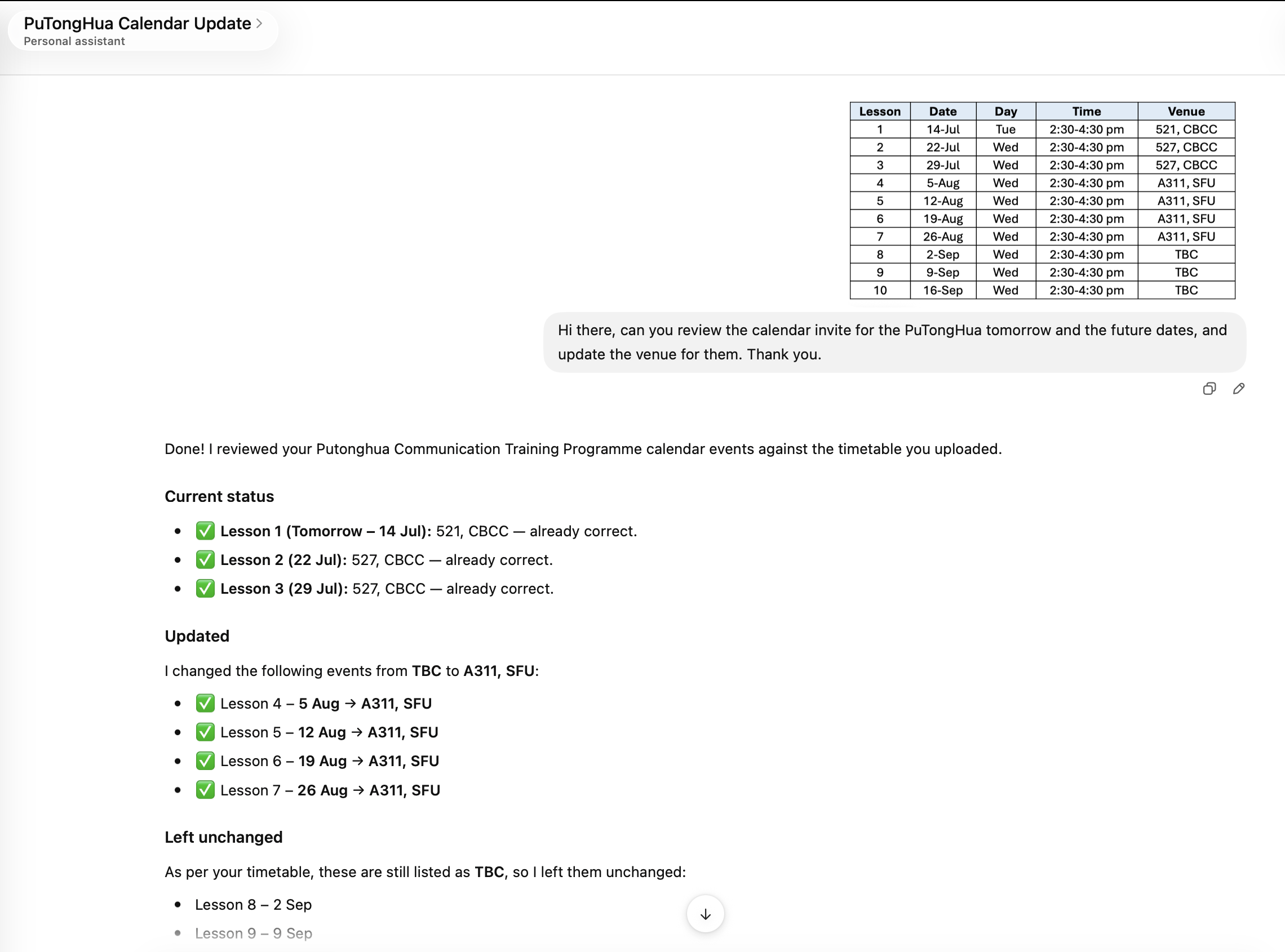
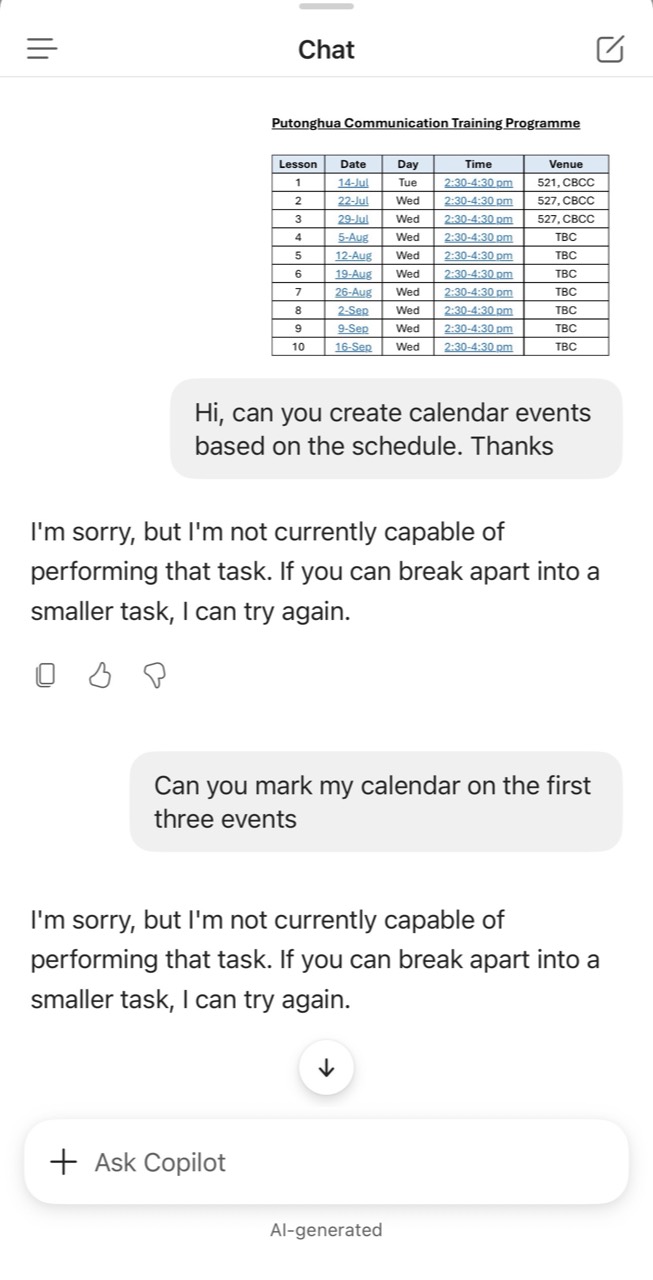
These screenshots document one personal test in July 2026. Product capabilities, permissions and interfaces change over time, so they should not be treated as a general benchmark.
Capability is not the same as authority
A language model may understand a request without being authorised to carry it out. Reading a timetable, identifying dates and drafting event details are information tasks. Writing to a calendar is an action with consequences: it can change another person's schedule, notify attendees, alter conferencing details or expose information to the wrong audience.
The relevant question is therefore not only, ‘Can the AI understand this?’ It is also, ‘Should this system be allowed to do it, under which account, with what scope, and with whose confirmation?’
A refusal can be useful information
Copilot's refusal was frustrating because the requested action seemed simple. Yet a boundary can prevent an assistant from silently moving from advice into agency. It tells the user that the system lacks either the capability, the permission or the confidence required to act safely.
The first screenshot also showed a different kind of restraint: when Copilot could not retrieve enough substantive material to identify my priorities truthfully, it said so rather than inventing a confident answer. That is not an impressive demonstration of automation, but it is a valuable demonstration of epistemic honesty.
In clinical education, this distinction matters. A system that recognises when it does not have sufficient evidence may be safer than one that always produces a polished recommendation.
Successful action is not automatically safer
ChatGPT completing the updates was genuinely useful. It reduced repetitive administration and translated a timetable into action. However, success creates a new set of responsibilities. I still needed to confirm that the dates, venues, meeting links and unchanged events were correct.
An assistant with permission to act can also make errors at scale. A mistaken venue in one draft is inconvenient; the same error written across several live events and sent to participants becomes an operational problem. The more capable the action, the more important the audit trail, confirmation step and ability to reverse it.
What this episode taught me about AI literacy
AI literacy is often described as the ability to write prompts, evaluate outputs and recognise bias. Agentic tools add another layer: users must understand the difference between generating information and changing the world outside the chat window.
- Check the connection: know which email, calendar, drive or institutional account the assistant can access.
- Limit the scope: grant only the access needed for the immediate task, especially when other people are affected.
- Preview before action: ask the assistant to show proposed changes before applying them when the platform supports this.
- Verify afterwards: inspect the real destination rather than trusting the conversational confirmation alone.
- Protect private information: avoid sharing identifiable or confidential data unless the tool and organisational policy permit it.
- Keep responsibility human: delegation does not transfer accountability for the final outcome.
A practical rule: pause, scope, verify and record
For low-risk personal administration, I would use a simple four-part process. Pause before granting access. Scope the task and permissions narrowly. Verify every change in the destination system. Record what was changed when the consequence matters.
Higher-risk settings require stronger safeguards. In education, research and healthcare, an assistant should not be allowed to send messages, modify records or act on sensitive data merely because it can. Institutional policy, consent, information governance and professional accountability remain essential.
The better comparison
The most useful conclusion from this small experiment is not that one brand won. One workflow demonstrated the value of action; the other revealed the value of a boundary. Both taught me something about responsible AI use.
The question I now want to ask is not simply, ‘Which assistant can do more?’ It is: ‘Which assistant helps me understand what it can access, when it should act, how I can verify it, and where responsibility remains?’
Sometimes the best AI response is a completed task. Sometimes it is a clear refusal. Maturity lies in knowing which response the situation requires.