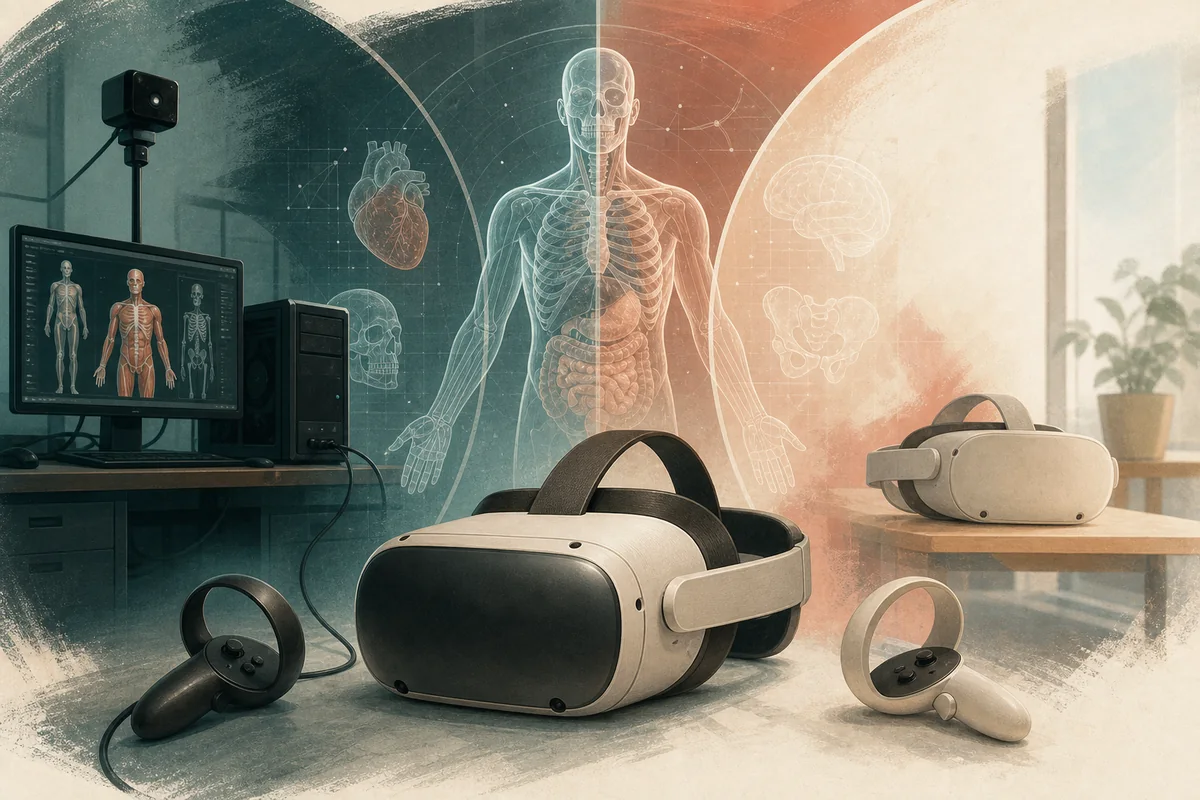
Virtual reality headsets vary considerably in price, computing requirements, tracking and ease of use. This comparison reflects my experience of three different positions in the market: PC-based HTC VIVE systems, the standalone Meta Quest 2, and Meta’s newer premium devices, including the Quest 3 and Quest Pro.
Product names and specifications change quickly, so this article is best read as an educational comparison rather than current purchasing advice.
HTC VIVE: high capability, greater complexity
PC-based VIVE systems can provide strong visual quality, accurate tracking and flexible room-scale experiences. They are well suited to specialist development, simulation and research where computing power and precise tracking matter.
The trade-off is complexity. Depending on the model, users may need a capable computer, cables, adapters, tracking equipment and more time to prepare the physical environment.
Meta Quest 2: accessible standalone VR
The Quest 2 made VR more approachable by combining wireless operation, inside-out tracking and a broad application library in one headset. It is relatively simple to deploy for demonstrations or small-group learning because it does not require a dedicated computer.
Its lower cost and ease of use are attractive in education, although comfort, account management, device hygiene and institutional data governance still need careful planning.
Quest 3 and Quest Pro: mixed reality and advanced use
The Quest 3 and Quest Pro occupy different positions, but both demonstrate the move towards improved passthrough and mixed-reality experiences. These features may be valuable when learners need to interact with both digital content and their physical surroundings.
For educators, the best headset is not necessarily the newest one. The decision should follow the learning objective, available applications, technical support, budget and requirements for privacy and infection control.
Choosing for education
A high-end system may be justified for research or complex simulation, while a standalone headset may be more practical for routine teaching. Pilot testing with students and staff is essential before investing at scale.