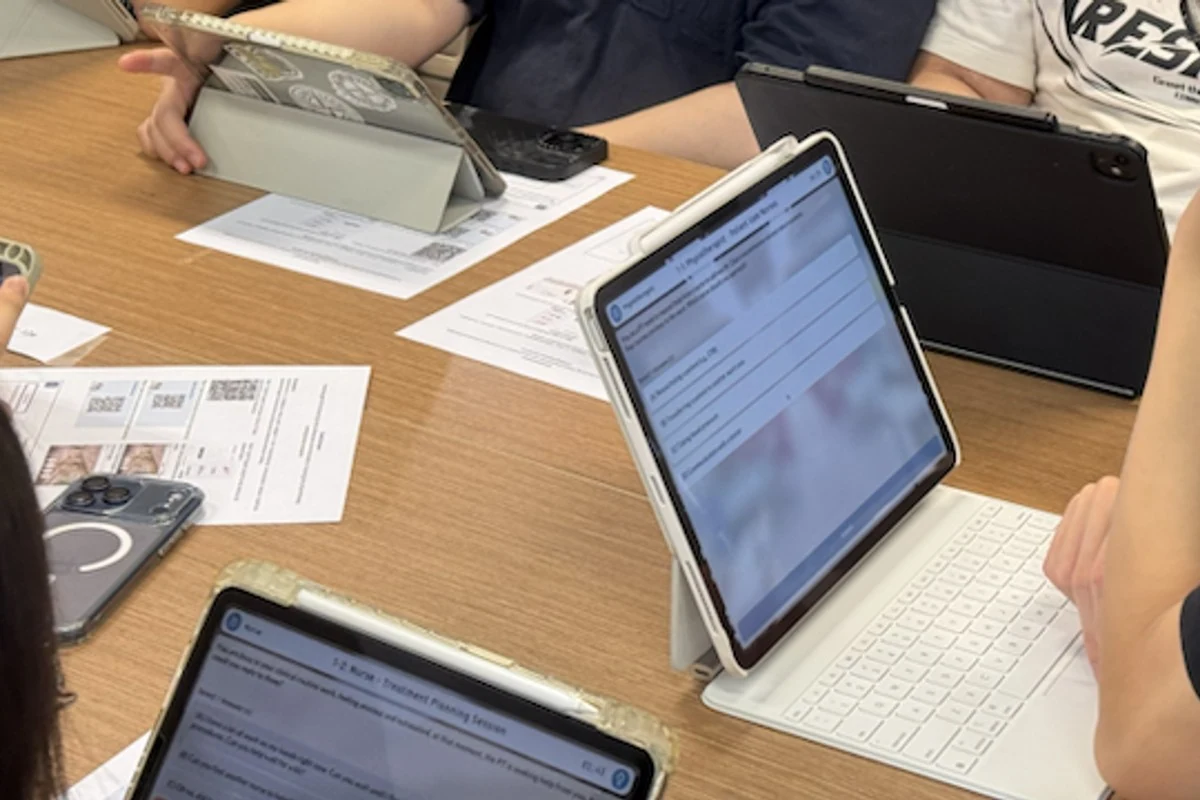
Group work is often described as an active-learning strategy, but placing students around a table does not automatically produce meaningful collaboration. Some groups divide the task efficiently without discussing the underlying ideas. Others talk at length while one person quietly carries the reasoning.
When I move around a classroom during a group activity, I am not only checking whether students are busy. I am looking for signs of how they understand the problem, where their reasoning diverges and which voices have not yet entered the conversation.
The process contains evidence
A final group answer can conceal the route taken to reach it. Listening to the discussion reveals which concepts students connect, what evidence they prioritise and where a confident statement rests on a fragile assumption. These moments provide formative information before a formal assessment is submitted.
The artefacts on the table also matter. Notes, diagrams, search choices, discarded options and revisions can show how a group is organising the problem. Digital devices may support this process, but the number of open screens is not evidence that collaborative learning has occurred.
Participation needs to be designed
Students bring different levels of confidence, language fluency and prior knowledge. An open instruction to discuss may therefore reproduce the same participation pattern each time. A small amount of structure can create fairer opportunities to contribute.
Roles such as initial reasoner, evidence checker, alternative proposer and summariser can help, provided they are rotated and remain connected to the learning outcome. A brief individual commitment before discussion also makes it harder for one answer to replace everyone's thinking.
Questions are more useful than rescue
When a group is stuck, the quickest response is to explain the solution. That may restore momentum, but it can also remove the reasoning students need to practise. A more useful intervention is often a question: What information are you using? Which assumption would change your answer? How would you explain this to another group?
The aim is not to leave students confused. It is to provide enough support for progress while keeping intellectual responsibility with the learners.
What I look for while circulating
- Whether students can state the problem before proposing a solution.
- Which evidence is being used, ignored or misunderstood.
- Whether disagreement leads to explanation or simply to a vote.
- Whose reasoning is shaping the answer and who remains silent.
- Whether digital tools are supporting comparison and explanation or replacing them.
- Which misconception is common enough to address with the whole class.
Before assessment makes it official
Group work gives educators an early view of learning while ideas are still forming. It offers a chance to respond before a misconception appears in an examination or a practical assessment, when feedback arrives too late to shape the current task.
The photograph does not show a finished answer. That is precisely its value: it captures learning as negotiation, revision and explanation rather than only as a final product.