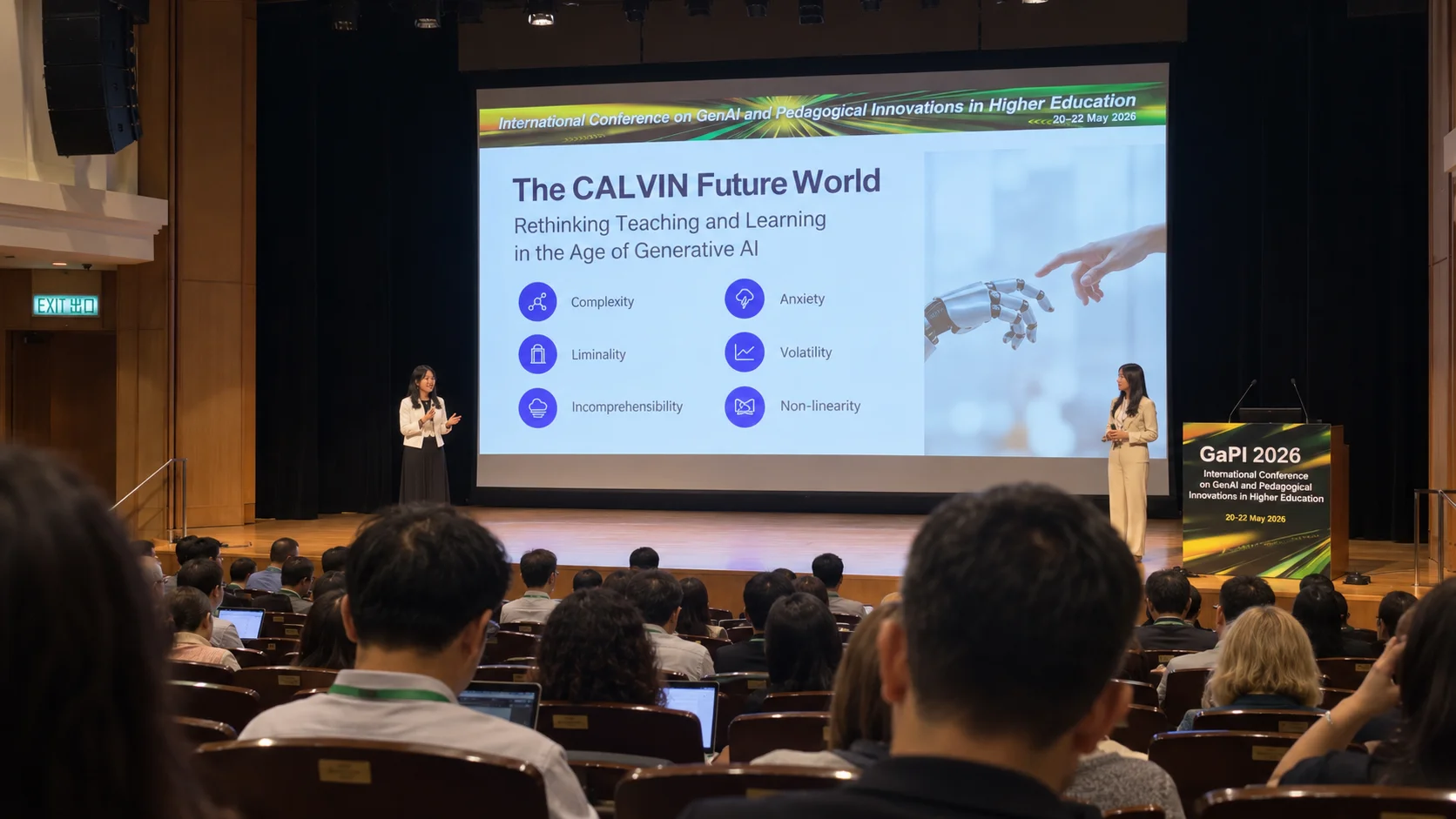
I recently attended the International Conference on GenAI and Pedagogical Innovations in Higher Education. What made the conference especially interesting was that the discussion was not only about tools. It pushed towards a deeper question:
What kind of education is needed in a world increasingly shaped by artificial intelligence?
The “AI tsunami” and curriculum reform
AI is not simply a new educational technology to be added into existing courses. It challenges some of the assumptions behind our curriculum design.
If students can now generate summaries, essays, explanations, treatment plans, case analyses, and study notes within seconds, then our assessments must ask for more than the reproduction of information.
Are we assessing memory? Reasoning? Judgement? Professional identity? The ability to use tools ethically and critically?
These questions are particularly important in health professions education.
From predictable education to complex learning
Clinical practice is shaped by uncertainty, incomplete information, changing situations, and human interaction. Generative AI can support learning, but it can also create new risks. It can provide fluent answers without necessarily providing sound judgement.
This means our role as educators is changing. We are increasingly becoming designers of learning environments where students can practise judgement, reflection, verification, and responsible decision-making.
Transformative learning in the age of AI
For students, transformative learning may involve moving from:
“How can AI give me the answer?”
to:
“How can AI help me think more deeply?”
For educators, it may involve moving from:
“How do I stop students using AI?”
to:
“How do I design learning that remains meaningful when AI is already part of the learning environment?”
My reflections as a physiotherapy educator
AI should not be treated as a shortcut to innovation. Educational design still matters.
AI literacy should also become part of professional education. Students need to learn how to engage critically with AI-generated information.
Finally, assessment needs to move closer to authentic professional practice. If an assessment can be completed entirely by AI without the student demonstrating judgement, reflection, or contextual reasoning, perhaps the assessment itself needs redesign.
Closing thought
The key question is no longer:
How do we use AI in education?
The more important question may be:
How do we design education for a world in which AI is already present?