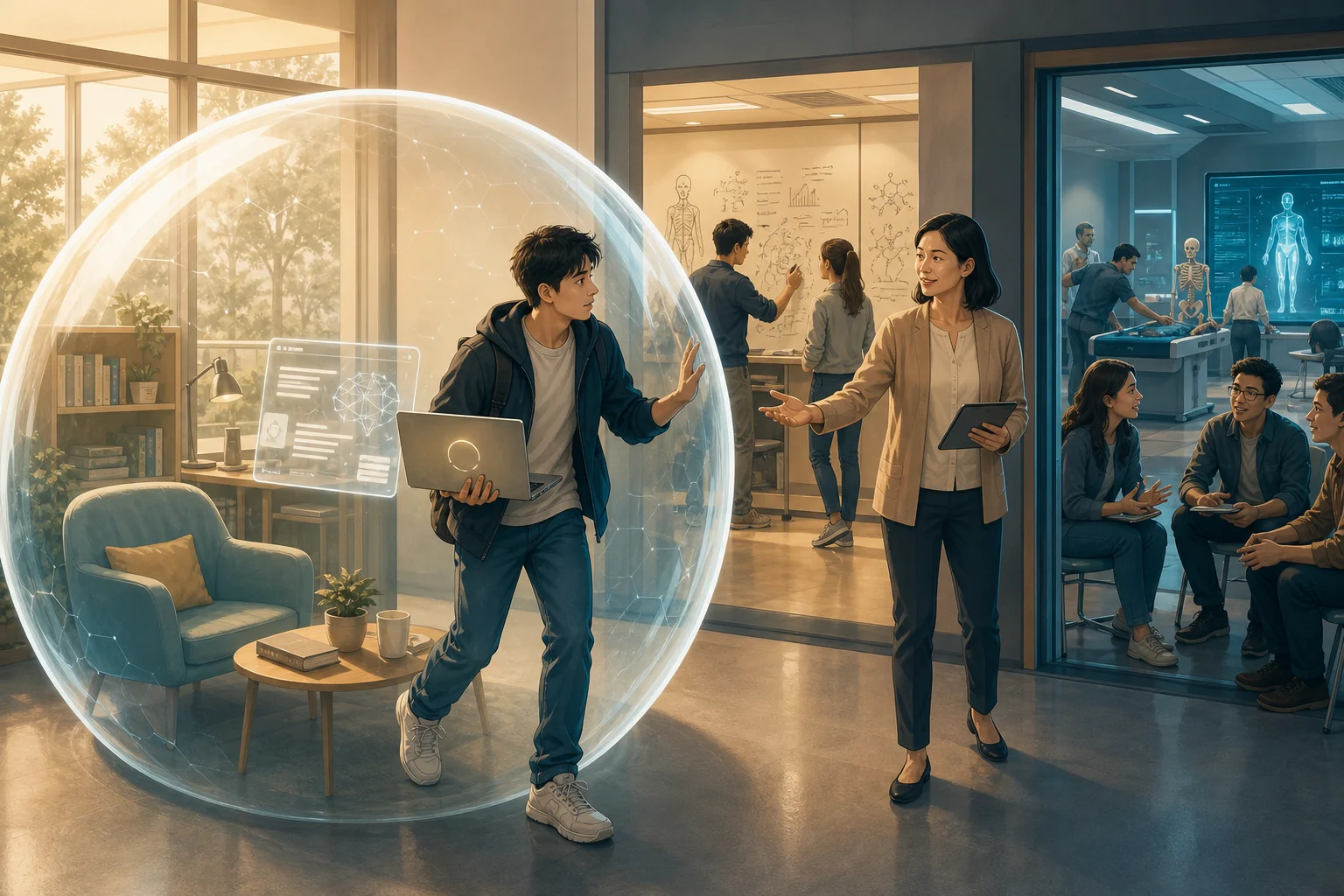
One of my rough notes began with a simple question: are students now learning inside a safer bubble than previous generations? The phrase is imperfect, but the concern is useful. Contemporary education rightly pays more attention to wellbeing, inclusion, accessibility and support. That is progress.
The problem begins when support quietly becomes over-protection, and when every form of difficulty is treated as something to remove. Generative AI makes this question more urgent because it can remove struggle at the exact point where struggle may be doing developmental work.
Not all difficulty is good
Some educational difficulty is wasteful: confusing instructions, inaccessible materials, unclear assessment criteria and hostile classroom cultures do not build resilience. They create avoidable barriers.
But some difficulty is productive. Students need to sit with uncertainty, test an idea, get it wrong, revise it and explain why a better answer is better. This matters in health professions education, where graduates must make decisions in messy, embodied and incomplete situations.
What AI changes
AI can now step into the exact moment where learning is supposed to happen. A student who is unsure how to begin can ask for a structure. A student who has not yet read deeply can ask for a summary. A student who cannot yet connect symptoms, anatomy and clinical reasoning can ask for a plausible plan.
The answer may look competent, but competence in the output is not the same as competence in the learner.
A safer bubble is not the same as a better education
A good learning environment should be safe enough for students to take intellectual risks. Students should be able to ask basic questions, attempt difficult tasks, fail in low-stakes settings and receive feedback without humiliation. That kind of safety is not softness. It is the condition that allows challenge to work.
The danger is a different kind of safety: a bubble where students are protected from difficulty, consequences and the need to defend their own reasoning.
Design AI around productive struggle
The answer is not to ban AI everywhere. It is to decide where struggle should remain visible.
- Students first attempt a case, question or draft before consulting AI.
- AI outputs are used as critique material rather than model answers.
- Students explain what they accepted, rejected and changed.
- Some assessments require oral defence, practical demonstration or real-time reasoning.
- Reflection focuses less on the prompt and more on the decision behind it.
The role of the educator
The educator's role is not to make learning unnecessarily hard. It is to preserve the right kind of challenge. AI should help students stay engaged with difficult work, not quietly remove the need to do it.
The goal is not a return to harsher education. It is a better distinction between barriers that should be removed and struggles that help students become capable.