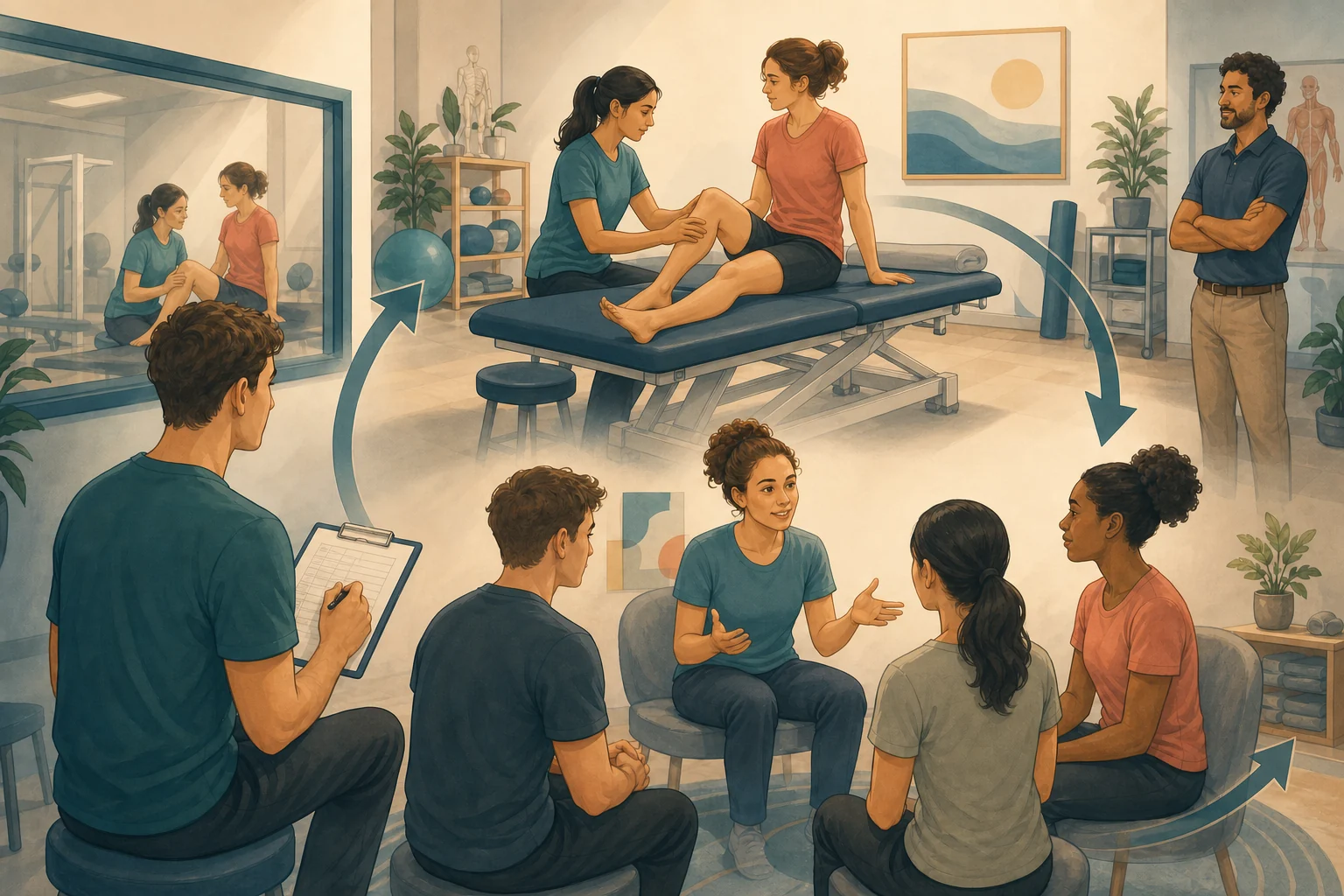
In health professions simulation, we often assume that the student playing the clinician is doing the real learning. Everyone else appears to be waiting, watching or helping the scenario run.
A project I am working on in undergraduate physiotherapy education has made me question that assumption. The early accounts suggest that peer patient, observer and peer debriefer roles may each support a different aspect of learning. That possibility is valuable, but it should not be confused with proof that role rotation improves clinical competence or readiness.
Performance is only one perspective
The learner in the clinician role must integrate assessment, treatment, communication, prioritisation and safety under pressure. This may help expose the difference between knowing separate techniques and managing a whole encounter.
But direct performance also consumes attention. When students are trying to remember a sequence, respond to a patient and manage time, they may not notice the wider interaction. Other roles may direct attention towards different parts of the encounter.
Four roles, four ways of seeing
These roles need not be treated simply as waiting activities for students who are not currently performing. Students' accounts suggest that they may be complementary learning positions. Whether these perceived benefits produce measurable or lasting improvements, however, remains uncertain.
- Learner: may support integration of knowledge, skills and clinical decision-making under pressure.
- Peer patient: may draw attention to how instructions, touch and communication are experienced by the person receiving care.
- Observer: may provide distance from performance, allowing students to notice aspects of reasoning, workflow, communication and safety.
- Peer debriefer: may provide practice in asking reflective questions and communicating feedback constructively.
Role rotation may broaden perspective
Students described noticing different things in different roles. A peer patient may become more aware of how instructions or techniques feel from the receiving side. An observer may notice a missed cue while carrying less of the cognitive load associated with direct performance. A peer debriefer may find that identifying an issue is easier than helping another person reflect on the reasoning behind it.
These accounts are consistent with the possibility that rotation broadens perspective. They do not establish perspective transformation as an outcome, nor do they show that perceived learning transfers to later clinical performance. Reflection may help students connect the experiences, but this mechanism requires further investigation.
Peer debriefing needs guardrails
Inviting students to facilitate debriefing may offer practice in feedback dialogue and reflective facilitation, but it should not mean asking an unprepared peer to critique classmates. Poorly supported peer debriefing can transmit incorrect information, become overly judgemental or undermine psychological safety.
Students need preparation in a structured framework, modelling, guided practice and language that separates curiosity from accusation. A trained educator should remain present as a safety net for clinical accuracy and psychological safety. Peer leadership does not remove faculty responsibility.
Fidelity is more than expensive equipment
A high-fidelity simulator does not automatically create high-quality learning. Psychological, conceptual and environmental fidelity depend on whether the case is coherent, the roles are credible, expectations are consistent and the activity aligns with its learning outcomes.
Peer patients need sufficient case detail to portray the person consistently. Observers need a focused observation guide rather than a vague instruction to watch. Peer debriefers need protected time. Clinical educators need shared standards so that feedback does not change unpredictably from one room to another.
Protect the reflection, not only the scenario
Simulation schedules may protect performance time and compress the debrief when the scenario runs late. This risks reducing the opportunity for learners to interpret the experience and consider what they might do differently next time.
If role rotation is intended to develop perspective, empathy, metacognition and feedback literacy, then debriefing time must be designed as part of the intervention—not treated as whatever time remains.
How I would design role rotation deliberately
- Write a learning purpose for every role, not only for the clinician role.
- Give peer patients structured case information and boundaries for portrayal.
- Use observation prompts that focus attention on reasoning, communication, professionalism and safety.
- Train peer debriefers, provide a framework and keep an educator available as a safety net.
- Calibrate facilitators and protect psychologically safe, non-graded participation where possible.
- Time-box the scenario so that reflection and a second attempt are not sacrificed.
- Evaluate what each role contributes instead of measuring only confidence after clinician performance.
What we can—and cannot yet—claim
The current project suggests that students perceive different forms of value in different roles: clinical integration in the Learner role, patient-centred awareness in the Peer Patient role, analytical distance in the Observer role and feedback dialogue in the Peer Debriefer role. These are role-related learning possibilities, not confirmed effects.
The study is based mainly on accounts from one undergraduate physiotherapy programme. It does not objectively measure clinical competence, placement performance, long-term retention or patient outcomes, and students may not have received equal exposure to every role. The findings therefore cannot establish that role rotation causes greater clinical readiness.
Further studies should compare deliberately designed roles, document exposure and preparation, use outcomes beyond self-report and examine whether any learning transfers to later simulation or clinical practice. Until then, the most defensible conclusion is modest: the clinician may not be the only learner in the room, and different roles appear to invite attention to different aspects of learning.
Project note
This reflection is informed by an ongoing manuscript about role rotation in high-fidelity undergraduate physiotherapy simulation. It shares provisional pedagogical interpretations rather than reporting final peer-reviewed findings. Participant quotations, identifiable details and unpublished data have intentionally not been included.
Selected reading informing the reflection
- O'Regan, Molloy, Watterson and Nestel: observer roles that optimise learning in healthcare simulation education.
- Sawyer and colleagues: approaches to debriefing in healthcare simulation.
- Carless and Boud: developing student feedback literacy.
- Mann, Gordon and MacLeod: reflection and reflective practice in health professions education.